The Early days
Updated: Jun 17
SEASON 1 - EPISODE 2
The early days of rasing a baby with special needs
Season 1 – Episode 2
The early days of raising a baby with special needs can feel overwhelming, emotional, and uncertain. This is my personal experience of navigating those early days and finding strength along the way.
The early days were the toughest for me. I didn’t know how to cope with a baby with special needs. It was so daunting. I was crippled by fear of the unknown, constantly dreading the future, building worst-case scenarios and catastrophising all the time. I just wasn’t coping mentally.
Louis’ early days were a whole new ball game compared to my firstborn. I went through the motions of motherhood — feeding him, changing him, cuddling him, talking to him. I felt protective towards him, but I had no bond, and that was what was destroying me. I remember wishing I could be taken into hospital and cured of how I felt, just to have everything taken away. It was too hard to live with the chronic, crippling anxiety I faced day in, day out.
In the first few weeks I tried to carry on with life as normal. I remember walking around the supermarket, sobbing uncontrollably, pushing the buggy with a tiny newborn and my toddler. I had no control over my tears — they just fell. I had never experienced a feeling like it. I felt such grief, even though my son was alive. It was the most awful and conflicting feeling. Many people said, “You are grieving for the child you didn’t have,” and that was exactly how I felt.
Why me?
Why us?
Life is going to be so hard.
How will it affect my other child?
How will we ever be a normal family?
Will he be bullied?
Will he be able to talk or walk?
There was a constant, obsessive chattering playing out in my head.
I attended all my mother-and-child groups as usual. I remember sitting there sobbing, as if the tears would never end, my mind spinning endlessly with the same obsessive thoughts. I don’t know how I carried on, but I wanted to keep things as normal as possible for my eldest child — even though inside I felt like I was going mad and dying.
My biggest guilt of all was wishing someone would take Louis away. If he wasn’t there, I thought I would feel normal again. I would be well again because the thing that was making me feel crazy would be gone. In my mind, that felt like the solution.
Then the disgust and hatred towards myself would kick in. How could I think something like that? What kind of monster was I? How could I be worthy of being a mother if I was capable of thinking such things?
Some of my behaviours became obsessive. I remember sitting in the back room at home, looking out at the garden, thinking the fences needed painting. It was a big garden with a lot of fencing. I went outside and painted every single fence panel and the decking, day after day, for weeks. I just couldn’t stop.
Looking back, it was such strange behaviour, but at the time it gave me a sense of achievement. I also developed a burning desire to run. When I was given the all-clear after my caesarean section, I ran — and ran and ran. It became my escape, my way of processing the stress. It was my coping mechanism.
Louis was likely to reach his milestones much later than his brother. Everything felt like a guessing game. There were no answers, which was incredibly frustrating. The appointments never seemed to end. Physiotherapy, ENT, cardiology, feeding teams, eye specialists — we were constantly at the hospital.
Although I knew it was necessary, each appointment was another reminder that my child had complications I couldn’t fix. It was daunting, frightening and exhausting. If I’m honest, it felt like an intrusion into what should have been a happy, enjoyable time with a newborn. Just as I began to settle, another appointment would come along, reminding me that things were not as they should be.
The first six months of Louis’ life were a blur. I remember certain days and moments, but I wasn’t really present. There was no real help available. We tried constantly to get support. Doctors prescribed antidepressants, but if I’m honest, they made me feel worse.
Eventually, I went to see a private psychiatrist. I told him about the thoughts and feelings I was having, and I remember him asking me if I was a perfectionist.
“Yes,” I replied. “One hundred percent.” He explained that with my personality type, accepting a child with special needs would have been incredibly hard. As someone who had always strived for perfection, the shock of having a child that I didn’t see as perfect conflicted deeply with my internal ideals. He also explained that the trauma of the extremely difficult pregnancy, combined with the birth diagnosis, had triggered post-traumatic stress on top of post-natal depression. Under the circumstances, he said, this was completely understandable.
I was prescribed a different antidepressant, and after a few weeks I began to feel slightly better. The brain fog would lift for a few days, then return. Slowly, the clear days became more frequent, and eventually I began to feel human again.
After about a year, I stopped taking the medication and continued running to help me mentally process everything. Post-natal depression and post-traumatic stress are utterly crippling. You feel helpless, alone, ashamed and guilty. The dark thoughts that engulf you are evil and mortifying.
I believed I wasn’t worthy of being a mother because of my inability to bond with Louis — even though he was such an incredibly easy baby. At the time I was deeply ashamed of my feelings, but now I understand how unwell I truly was. None of it was a conscious choice. I was desperately ill.
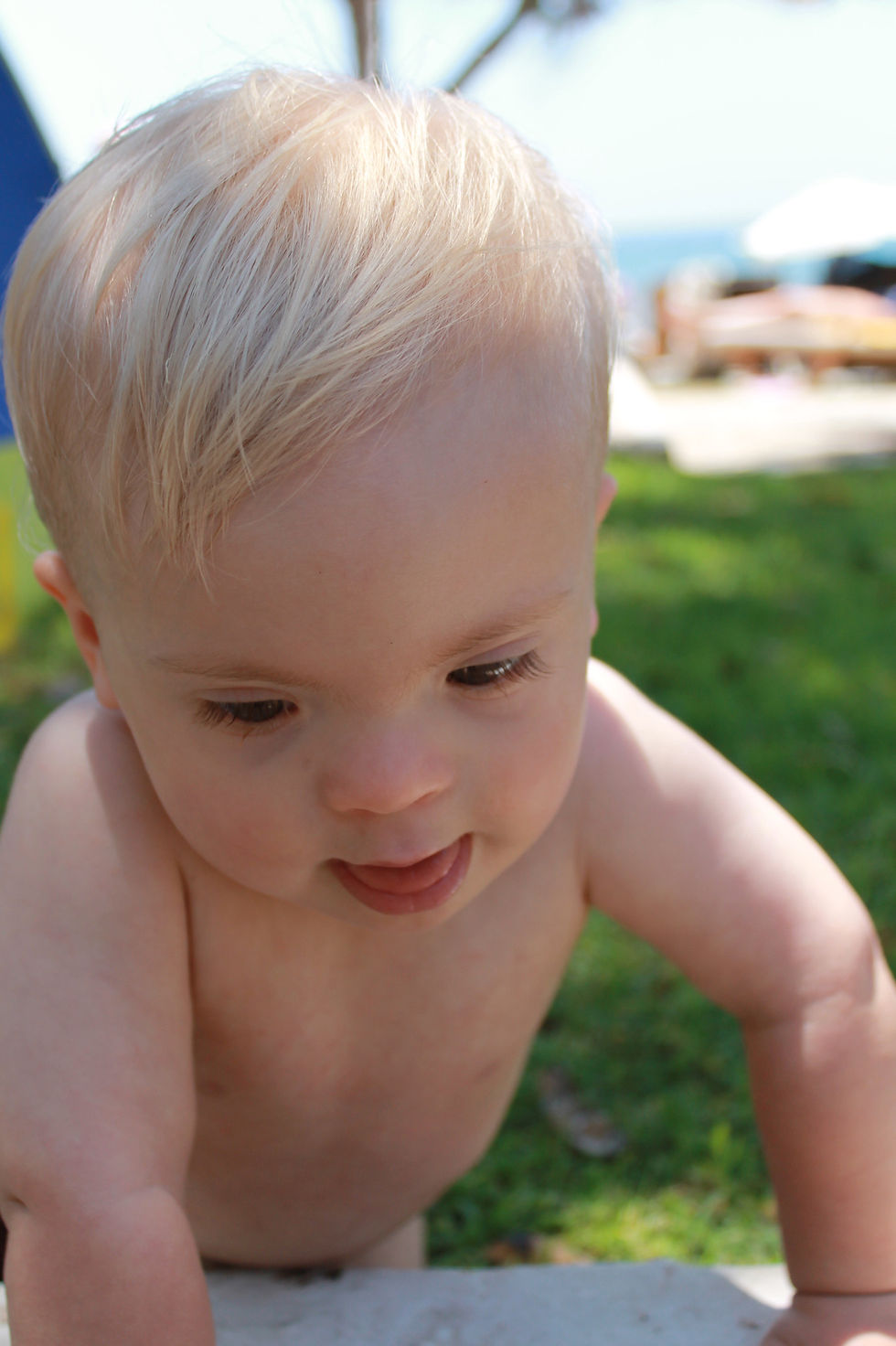
It feels strange looking back at photos of Louis as a baby now. I can’t believe how absolutely gorgeous he was. It makes me sad that I couldn’t see it then — all I could see was the diagnosis. I was impatient, waiting for milestones, wishing I could fast-forward to a place where I felt able to cope.
I have since learned that life’s challenges are things you have to move through step by step. You can’t fast-forward. You can’t run away. You have to deal with what is in front of you. And in doing so, those challenges shape you into a stronger, more compassionate and resilient person.
It is my hope that by sharing my experience, I can help educate hospitals, nurses and doctors about the absolute importance of allowing a mother to hold, love and bond with her baby before delivering a life-changing diagnosis.
I understand that in some circumstances doctors need to act quickly — particularly when there is a life-threatening condition. But in Louis’ case, there was no medical emergency. What could have been prevented was the total disconnection I felt from my son. A diagnosis that could have waited until I had held him, loved him, and felt his skin against mine.
Had that happened, I truly believe the outcome for me mentally would have been very different.
Suffering with post-natal depression and post-traumatic stress is an incredibly lonely place. Relief can come when you are able to share your feelings in a safe space with someone who understands — someone who has lived it.
I’m often asked why I didn’t receive a diagnosis during pregnancy. None of my antenatal scans showed cause for concern. My NT scan was normal, and I was classed as low risk, so I was never offered amniocentesis.
Non-invasive prenatal testing (NIPT) is a blood test that screens for Down syndrome, Edwards’ syndrome and Patau syndrome. It became available in the NHS in England in June 2021. At the time of my pregnancy, it was largely only available privately.
A nuchal translucency (NT) scan is a non-invasive prenatal ultrasound performed between 11 and 14 weeks of pregnancy. It measures the fluid at the back of the baby’s neck and can indicate the likelihood of chromosomal conditions or congenital heart problems.
Amniocentesis is offered only when there is a higher likelihood of a genetic condition and involves testing amniotic fluid taken from the womb. It is a personal choice and not routinely offered to all pregnant women.
If you have had a birth diagnosis, a pregnancy diagnosis, or you are parenting a child with additional needs and need support, I can help.
Please contact me for a free introductory chat.




Comments